



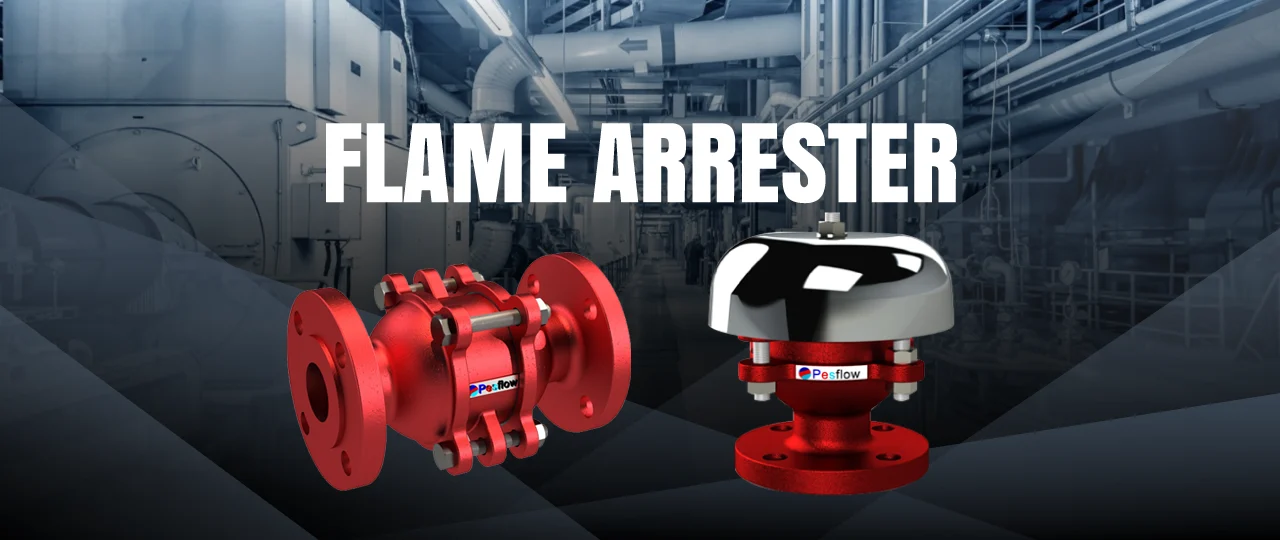
Choosing the Right Flame Arrester for Industrial Safety
In industrial process plants, the risk of fire or explosion in piping systems and storage tanks is a constant reality. As a leading provider of safety solutions, Perfect Engineering Services prioritizes the integration of high-performance Flame Arresters to mitigate these risks.
But effective safety isn’t about just installing “any” arrestor; it is about understanding the fluid dynamics, combustion chemistry, and mechanical specifications that suit your specific application.
1. The Core Technology
The “heart” of our flame arresters is the Crimped Ribbon Metal Element. Unlike older wire mesh designs, the crimped ribbon consists of thin metallic strips wound tightly to create a series of uniform, tiny triangular apertures.
The Quenching Principle: These apertures act as “quenching gaps.” When a flame front hits the element, it is broken into thousands of “micro-flames.” The massive surface area of the metal element rapidly absorbs the heat of the combustion, dropping the temperature of the gas below its Auto-Ignition Temperature (AIT), effectively extinguishing the flame.
Low Pressure Drop: Our design ensures that while flames are blocked, the flow of vapors is not significantly restricted, maintaining process efficiency.
2. Classification by Installation: End-of-Line vs. In-Line
A. End-of-Line Flame Arresters (Deflagration)
These are installed on the vent nozzles of storage tanks or at the end of a short exhaust pipe.
Application: They prevent an external fire (caused by atmospheric ignition sources like lightning or sparks) from entering the tank.
Technical Limitation: They are tested only for deflagrations (low-speed flames) and must be installed close to the potential ignition source.
B. In-Line Flame Arresters (Deflagration & Detonation)
Installed within a piping system, these are designed to handle more violent combustion events.
In-Line Deflagration Arresters: Used when the ignition source is relatively close to the arrestor.
In-Line Detonation Arresters: Mandatory for long piping runs. When a flame travels through a pipe, it accelerates. If it reaches supersonic speeds and creates a shockwave, it becomes a detonation. Our detonation arresters are engineered to withstand the extreme shock pressures associated with “Stable” and “Unstable” detonations.
3. Understanding Gas Groups and MESG
The choice of a flame arrester depends heavily on the Maximum Experimental Safe Gap (MESG) of the gas being handled. We categorize our arrestors based on international gas groupings:
Group IIA (D): For gases like Propane and Methane (Large MESG > 0.9mm).
Group IIB3 (C): For gases like Ethylene (Medium MESG 0.5mm to 0.9mm).
Group IIC (B): For highly volatile gases like Hydrogen (Small MESG < 0.5mm).
Perfect Engineering Services provides specialized IIC-rated arresters with ultra-fine element gaps specifically designed for hydrogen applications.
4. Technical Specifications & Material Standards
To ensure longevity in corrosive environments, we offer a wide range of material configurations:
Housing Materials: Carbon Steel (WCB), Stainless Steel (CF8/304, CF8M/316), and specialized alloys like Hastelloy for highly corrosive vapors.
Element Materials: Primarily SS316L for superior heat and corrosion resistance.
Sizes: Available from 1/2” (DN15) up to 24” (DN600) or larger upon custom request.
Flange Connections: Standard ANSI B16.5 (150# / 300#), DIN, or JIS, depending on your piping requirements.
Compliance: Our units are designed and tested in accordance with ISO 16852, EN 12874, and ATEX directives, ensuring they meet global safety benchmarks.
5. Maintenance
A flame arrester is only as good as its cleanliness. If the element gaps are clogged with debris or polymer buildup, pressure drop increases, potentially causing tank rupture.
Easy Access Design: Our arresters feature a “removable bank” design, allowing maintenance teams to easily slide out the element for inspection and cleaning without dismantling the entire piping system.
Why Trust Your Safety to Perfect Engineering Services?
At Perfect Engineering Services, we don’t just supply equipment; we provide engineered safety. We analyze your L/D ratio (Length-to-Diameter), operating temperatures, and pressure setpoints to recommend a flame arrester that guarantees protection without compromising your process flow.
Ensure full compliance with international safety protocols and protect your industrial infrastructure with our high-performance solutions.
Whether your application requires a deflagration or detonation arrester, Perfect Engineering Services provides precision-engineered hardware tailored to your specific operational parameters.
[Contact our technical team today for a consultation.]