



A Technical Guide to Selecting Industrial Flame Arresters
In the chemical process industry, storage tanks and vessels containing flammable mixtures are a standard yet high-risk reality. To mitigate the catastrophic potential of a fire or explosion spread, Flame Arresters serve as the critical line of defense.
At Perfect Engineering Services, we specialize in providing high-performance safety solutions designed to stop the spread of fire, limit explosive events, and confine flames within controlled locations. Understanding the mechanics and types of these devices is essential for any facility aiming for uncompromising safety and regulatory compliance.
How it Works: The Principle of MESG
The fundamental operation of a flame arrester relies on the Maximum Experimental Safe Gap (MESG). When a flammable mixture enters the narrow channels of the arrester’s corrugated matrix, heat is rapidly transferred from the flame front to the walls of the gap.
By forcing the flame through these precisely sized channels, the heat transfer extinguishes the flame and prevents “flashback” while allowing unburned gas to flow through. The narrower and longer the gap, the more effectively the “cold wall” influences the flame profile to stop its propagation.
Categorizing the Threat: Deflagration vs. Detonation
Before selecting an arrester, it is vital to understand the nature of the explosion you are guarding against:
Deflagration: An explosion that propagates at subsonic velocity. This can occur in open air (atmospheric), in confined volumes (pre-volume), or within a pipe (in-line).
Detonation: A violent explosion propagating at supersonic velocity, characterized by a high-pressure shock wave.
Essential Types of Flame Arresters
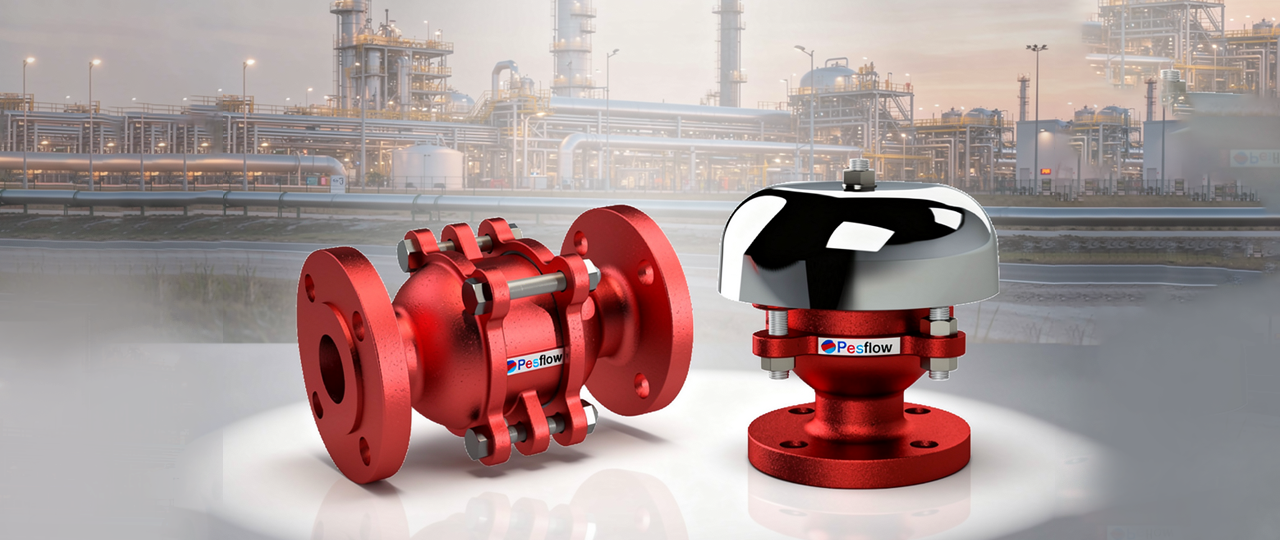
Based on your piping configuration and the potential ignition source, we provide four primary configurations:
- End-of-Line Deflagration Flame Arrester
Installed on tank vent nozzles or the terminal point of a vent line.
Purpose: Prevents an external atmospheric fire from entering a storage tank.
Capability: Designed for subsonic flame speeds where there is no significant pressure build-up.
- In-Line Deflagration Flame Arrester
These are installed within a piping system where the ignition source could be on either side of the device.
Design: Engineered to stop accelerated explosives within the pipeline before they transition from subsonic to supersonic speeds.
- In-Line Detonation Flame Arrester
In long pipe runs or systems with multiple bends, a flame has the “runway” to accelerate into a detonation.
The Ultimate Defense: These robust devices are engineered to extinguish both stable and unstable detonations, protecting your system against supersonic shock waves.
- In-Line Eccentric Bi-Directional Flame Arrester
This is a specialized solution for horizontal pipelines where moisture or heavy vapors are present.
The Eccentric Advantage: Unlike standard concentric arresters, the eccentric type features an offset, flat-bottom design.
Liquid Management: This design prevents the accumulation of liquid condensate at the bottom of the arrester. By ensuring the corrugated matrix remains clear of liquid, the device maintains a low pressure drop and prevents corrosion or blockage of the safety element.
Bi-Directional: It offers identical protection from flames originating from either direction.
Technical Specifications & Selection Criteria
To ensure the arrester matches your specific chemical environment, we follow the IEC Group classification for MESG selection:
IEC Group Reference Material MESG (mm)
IIA Propane > 0.9
IIB Ethylene 0.5 – 0.9
IIC Hydrogen < 0.5
Material Construction & Special Features
Our flame arresters are built for durability and ease of maintenance:
Premium Materials: Body options include A216 Gr. WCB, SS 304, and SS 316. Flame elements/cages are available in SS 304, SS 316, SS 316Ti, and Hastelloy
Corrosion Resistance: Optional Fluoropolymer-coated bodies and hardware provide outstanding resistance to harsh chemicals.
Maintainability: The removable corrugated matrix element allows for easy inspection, cleaning, and replacement, ensuring less clogging and downtime.
Monitoring: All types include provisions for standard temperature ports to monitor for Short-term burning (3-5 minutes) or Endurance burning (unlimited time).
Global Standards: All products are designed and manufactured as per API 2000 7th Edition and tested according to ISO 16852.
Why Perfect Engineering Services?
Selecting the right flame arrester is a matter of precision engineering and deep technical knowledge. Whether you require an eccentric design for horizontal lines or a detonation arrestor for high-risk pipelines, we provide the expertise to keep your plant compliant and your personnel safe.
Ensure your facility is protected by the best.
Visit perfectengineeringservices.co.in to explore our full range of safety devices or consult with our engineering team for a customized solution.