



The Ultimate Guide to Steam Pressure Reducing Stations (PRS): Technical Architectures for Industrial Efficiency
- Home
- Blog
The Ultimate Guide to Steam Pressure Reducing Stations (PRS): Technical Architectures for Industrial Efficiency
In industrial thermal plants, steam is typically generated at high pressures for efficient distribution. However, equipment like heat exchangers and reactors require lower pressures to maximize heat transfer.
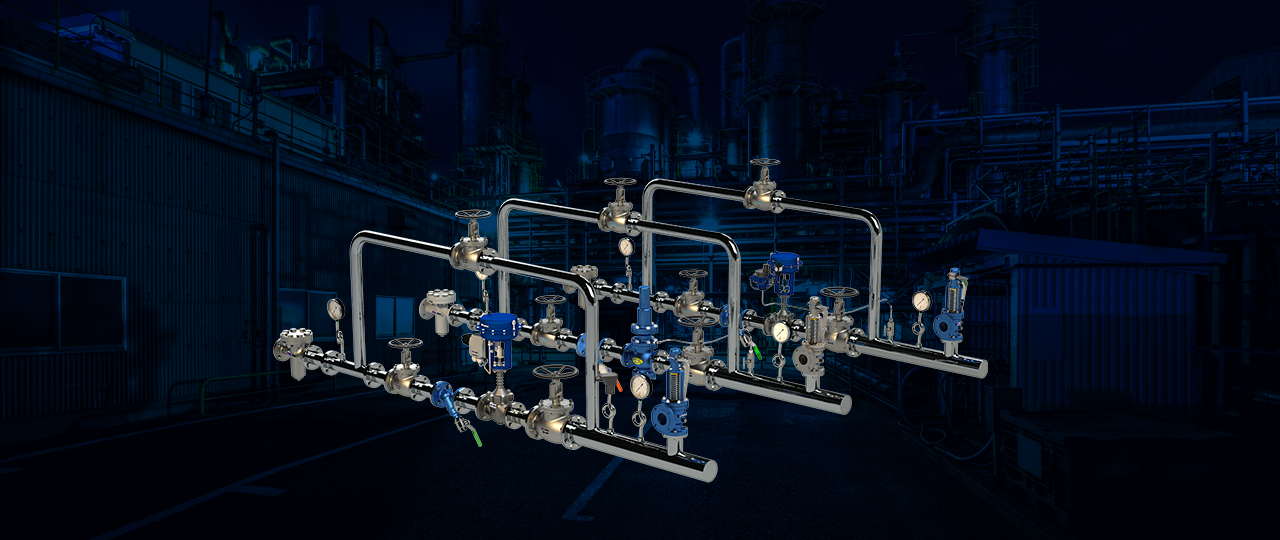
This is where a Steam Pressure Reducing Station (PRS) acts as the heartbeat of your system. At Perfect Engineering Services (PES), we don’t believe in a one-size-fits-all approach. We offer three distinct engineering variants designed to meet specific precision, automation, and process requirements.
1. The Three PRS Variants by Perfect Engineering Services
Choosing the right station depends on your required accuracy, turndown ratio, and integration with plant automation (SCADA/DCS).
Variant 1: Self-Acting Pilot Operated PRS
The most robust and widely used configuration for standard industrial applications.
The Technology: Utilizes a Pilot-Operated Pressure Reducing Valve (PRV) that uses the steam’s own energy to modulate pressure.
Best For: Applications with relatively steady loads where external power (electricity/air) is not available or desired.
Our Advantage: Our pilot-operated valves offer superior diaphragm life and +/- 1% set-point accuracy without needing a controller.
Variant 2: High-Precision PID & Electro-Pneumatic PRS
For processes where even a minor pressure fluctuation can ruin product quality.
The Technology: Features a Pneumatic Control Valve equipped with an Electro-Pneumatic (E/P) Positioner and a Digital PID Controller.
Best For: Highly automated plants (Pharma, Food Processing, Fine Chemicals) that require remote set-point changes and integration with a central PLC/DCS.
Our Advantage: Offers the highest turndown ratios and the ability to handle rapid “step-changes” in steam demand with zero hunting.
Variant 3: The Robotrol Powered PRS
A specialized, heavy-duty solution for demanding environments.
The Technology: A Control Valve integrated with the Robotrol system—a unique control architecture designed for maximum reliability and mechanical-electronic hybrid precision.
Best For: Harsh industrial environments or critical utility lines where fail-safe performance and robust mechanical feedback are non-negotiable.
Our Advantage: The Robotrol variant is engineered for “extreme-duty” cycles, providing a ruggedized alternative to standard electronic controllers.
Key Components of a High-Performance Steam PRS
Regardless of the variant we have, every station is built on a foundation of high-integrity components to ensure Zero-Downtime:
Moisture Separator & Steam Traps: “Wet steam” causes wire-drawing (erosion). We ensure only dry, saturated steam enters the control element, doubling the station’s lifespan.
High-Integrity Isolation Valves: Our forged steel Gate and Globe Valves ensure bubble-tight shut-off for safe maintenance.
Strainers: Essential for protecting the PRV or Control Valve internals from scale and pipeline debris.
Safety Relief Valve (SRV): The final line of defense. Sized for full discharge capacity to protect downstream assets from over-pressurization.
Pressure Gauges: High-visibility, glycerin-filled gauges at the inlet and outlet for real-time performance monitoring.
Design and Sizing: Why "Perfect" Engineering Matters
Sizing a Steam PRS is not about matching the pipe size; it is about Thermodynamic Mass Flow Rates.
Undersizing starves your process and causes “Sonic Choking.”
Oversizing leads to “Valve Hunting,” causing rapid seat wear and erratic pressure control.
Our Engineering Protocol
Velocity Control: We maintain steam velocity within 25-30 m/s to eliminate noise and vibration.
Turndown Management: We calculate the station’s ability to handle both peak loads and minimum night-time flows.
Material Excellence: Using ASTM A105 Forged Steel or A216 WCB Cast Steel to withstand constant thermal cycling.
Maintenance Tips for Industrial Longevity
Blowdown the Strainer: Weekly clearing of debris prevents valve jamming.
Sensing Line Integrity: Ensure pilot or sensor lines are clear of condensate for accurate feedback.
Trap Inspection: A failed-closed trap upstream can send a “slug” of water into the station, causing catastrophic Water Hammer.
Conclusion
A Steam PRS is a critical investment. Choosing a low-cost, non-standardized assembly might save 10% on initial costs but can lead to a 1000% loss in production downtime.
Perfect Engineering Services provides turnkey, pre-fabricated, and skid-mounted solutions across all three variants—Self-Acting, PID/Positioner-Led, and Robotrol.
Are you looking to optimize your steam system?
Contact our Technical Team for a custom sizing consultation for your Self-Acting or Control Valve-based PRS.